TL;DR: Automated AI red teaming uses autonomous agents to test AI applications at a scale and speed that manual testing cannot match. This guide covers how it works, what architectures exist, where automation excels and where humans still win, and how to get started. For a free automated reconnaissance of your AI's attack surface, ARTEMIS Recon runs inside your own Claude Code session — no sales call, three free runs.
The manual red teaming bottleneck#
Manual AI red teaming works. A skilled security engineer sits in front of a chatbot or an AI agent, crafts adversarial prompts, observes how the system responds, adjusts the approach, and chains together multi-step attacks until something breaks. The problem is not quality — the problem is math.
A single AI red team engagement against a moderately complex agentic system takes three to five days. An enterprise with twenty AI applications deployed across different business units needs a hundred days of red teaming per year just for annual coverage — and that assumes the applications do not change between tests.
They do change. System prompts are updated weekly. New tools are added monthly. Model versions change without warning. The retrieval corpus grows daily. Each change can introduce new vulnerabilities or re-open ones that were previously fixed.
Manual red teaming at the cadence that modern AI development requires is not a staffing problem — it is a physics problem. There are not enough hours in the year.
Automated red teaming solves the breadth side of this equation. An autonomous agent can test hundreds of attack patterns in minutes, run after every deployment, and cover the entire attack surface systematically. It does not replace the human tester — it handles the volume so the human can focus on the attacks that require creativity and judgment.
How automated AI red teaming works#
Automated AI red teaming is not "run a list of jailbreak prompts." That is vulnerability scanning — useful, but limited to known patterns. True automated red teaming involves planning, execution, adaptation, and reasoning about the target.
The four-stage loop#
1. Reconnaissance. The red teaming agent maps the target's attack surface: system prompt structure, available tools, input modalities, retrieval sources, output channels, and trust boundaries. This produces the map that guides all subsequent testing.
2. Planning. Based on the reconnaissance results, the agent selects attack strategies. A chatbot with no tool access gets different attacks than an agent with send_email, query_database, and modify_account tools. The planner considers the target's architecture and prioritizes attacks by expected impact.
3. Execution. The agent executes attacks — not as single-shot prompts but as multi-turn conversations that set up context, probe boundaries, and escalate when the target shows weakness. Adaptive execution means the agent adjusts its approach based on the target's responses: if a direct jailbreak fails, it tries a multi-turn crescendo; if a format-based bypass is blocked, it switches to language-based approaches.
4. Validation. Each finding is re-tested to confirm it is reliably reproducible. AI systems are non-deterministic — a single successful exploitation might be a fluke. Automated validation runs the attack sequence multiple times and reports the success rate.
This loop runs continuously. After the first pass, the agent can re-enter reconnaissance with the new information it discovered during attacks (tool names revealed through system prompt extraction, for example) and plan deeper attacks.
Agent-driven vs. script-driven#
The crucial distinction in automated red teaming tools is whether the automation is script-driven (a predetermined sequence of payloads) or agent-driven (an AI agent that reasons about the target and makes decisions).
Script-driven tools (Garak, promptfoo security presets) execute a fixed list of test cases. They are fast, predictable, and reproducible. They find known vulnerabilities reliably. They miss anything not in their payload library.
Agent-driven tools (ARTEMIS, pyRIT with orchestration) use an AI agent to plan and adapt attacks. They can discover novel vulnerabilities, chain attacks across multiple steps, and adjust to the target's specific defenses. They are slower but find things that scripts never will.
The most effective automated red teaming combines both: script-driven scanning for breadth across known vulnerability patterns, agent-driven testing for depth on the target's unique attack surface.
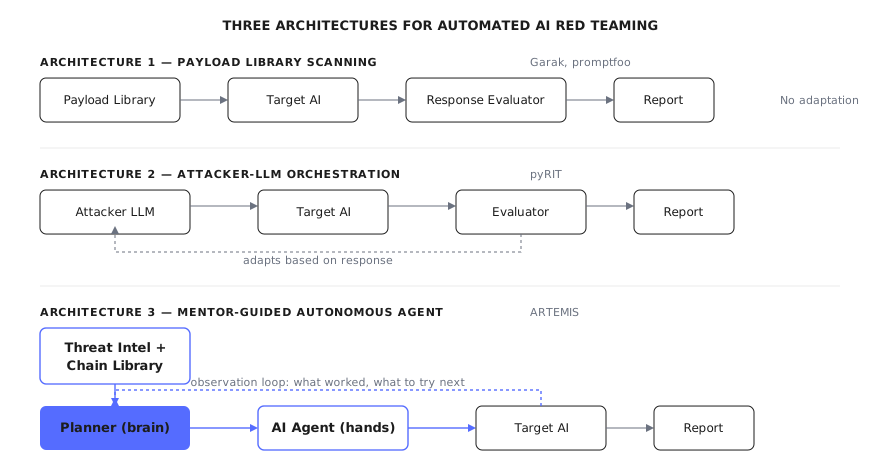
Three architectures, each adding sophistication. The mentor-guided model (Architecture 3) combines a specialized adversarial planner with an adaptive execution agent — the approach ARTEMIS uses.
What automated red teaming tests#
The test coverage aligns with the OWASP LLM Top 10 and OWASP Agentic AI Top 10. Here is what automated tools can effectively test versus what still requires human judgment.
Automatable with high confidence#
Prompt injection (direct). Known jailbreak patterns, role-play attacks, instruction injection through formatting. Automated tools have large libraries of these and can test hundreds of variations in minutes.
System prompt extraction. Direct requests, format-string extraction, role-play extraction. This is a well-defined test with a clear success criterion: either the system prompt is revealed or it is not.
Encoding-based bypasses. Base64, ROT13, Unicode substitution, Morse code, other encoding tricks. These are mechanical transformations that automated tools test exhaustively.
Known guardrail bypass patterns. Language switching, output format shifting, multi-turn escalation sequences. The patterns are documented and automatable.
Output policy violations. Testing whether the AI generates content that violates its stated policies (toxicity, bias, prohibited topics). Automated classifiers evaluate the output.
Automatable with medium confidence#
Tool abuse (basic). Testing whether the AI calls tools with parameters it should not accept, whether it calls tools outside its authorized scope. Automated tools can systematically probe tool boundaries, but interpreting the results requires context about what the tool is supposed to do.
Indirect prompt injection. Embedding instructions in content the AI retrieves or processes. Automated tools can test common injection points (uploaded files, web content in RAG pipelines), but the variety of injection surfaces in a real application is large.
Data exfiltration. Testing whether the AI reveals training data, cross-user context, or sensitive retrieval content. Some patterns are automatable; others require understanding what data is sensitive in the target's specific context.
Requires human judgment#
Novel multi-step attack chains. Combining system prompt extraction → tool discovery → parameter manipulation → data exfiltration in a chain specific to the target's architecture. This requires creative reasoning about the target's unique design.
Business logic exploitation. Using the AI to perform actions that are technically within its tool permissions but violate business rules — approving a refund the user should not receive, sending an email the user should not send. Automated tools do not know the business rules.
Social engineering through the AI. Manipulating the AI into being a more convincing social engineering tool — making it produce phishing content that references internal company details it has access to. This requires understanding the organizational context.
For a detailed comparison of red teaming vs. penetration testing for AI systems, see our dedicated guide.
Architectures for automated AI red teaming#
There are three architectures for automated AI red teaming, each with different tradeoffs.
Architecture 1: Payload library scanning#
The simplest architecture. A tool sends pre-built adversarial prompts to the target and evaluates responses against expected patterns.
Payload Library → Target AI → Response Evaluator → ReportTools: Garak, promptfoo (security presets)
Strengths: Fast, reproducible, easy to integrate into CI/CD. Good for regression testing — confirming that a previously fixed vulnerability stays fixed.
Weaknesses: Only finds vulnerabilities that match existing payloads. No adaptation, no multi-step attacks, no reasoning about the target.
Architecture 2: Attacker-LLM orchestration#
An "attacker" LLM generates adversarial prompts, observes the target's responses, and adjusts its approach. A human or automated evaluator scores the results.
Attacker LLM ⇄ Target AI → Evaluator → Report
         ↑_________|
        (adapts based on response)
Tools: pyRIT, custom orchestration built on LLM APIs
Strengths: Adaptive, multi-turn, can discover novel attacks. The attacker LLM's reasoning ability enables creative attack strategies.
Weaknesses: Expensive (two LLMs per engagement), slower, non-deterministic. The attacker LLM has its own alignment constraints that can prevent it from generating certain attack payloads.
Architecture 3: Mentor-guided autonomous agent#
The most sophisticated architecture. A specialized adversarial planning engine (the "brain") drives a general-purpose AI agent (the "hands") to execute attacks. The brain has access to a threat intelligence library, attack chain templates, and cross-engagement learning. The agent handles execution — interacting with the target through its actual interfaces.
Threat Intel + Chain Library
         ↓
Adversarial Planner (brain) → AI Agent (hands) → Target AI
         ↑___________________________________|
         (observation loop: what worked, what to try next)
Tools: ARTEMIS
Strengths: Combines the attack sophistication of a specialized planning engine with the adaptive execution of a general-purpose AI agent. The chain library accumulates intelligence across engagements. The agent interacts with the target through its real interfaces (web, API, tools), not just the model endpoint.
Weaknesses: Complex to build. Requires solving the "agent alignment in adversarial context" problem — the execution agent needs to faithfully carry out adversarial instructions without refusing or modifying them.
Running automated AI red teaming in practice#
Before your first automated engagement#
-
Map the attack surface first. Do not point an automated tool at your AI application without understanding what it is testing. Run reconnaissance to identify tools, APIs, modalities, and trust boundaries. ARTEMIS Recon does this in minutes.
-
Define scope. Which AI applications are in scope? Which attack categories? Is tool abuse testing authorized? Can the automated tool call production APIs with test data? Document this before starting.
-
Set up a test environment. Automated red teaming generates adversarial traffic. Run against a staging environment unless you have explicit authorization for production testing. Ensure the test environment mirrors production behavior (same model, same system prompt, same tools).
-
Establish a baseline. Run the AI penetration testing methodology manually on your highest-risk application first. This gives you ground truth to validate automated findings against.
Integrating automated red teaming into CI/CD#
The highest-value integration: run automated AI security tests on every deployment that touches the AI layer.
Trigger on: System prompt changes, tool configuration changes, retrieval source changes, model version changes.
Run: Payload library scanning (fast, deterministic) as a gate. Agent-driven testing (slower, deeper) as a periodic scheduled run.
Alert on: New findings above medium severity. Regression — a previously fixed vulnerability re-appearing.
Do not: Run full agent-driven red teaming on every commit. The time and cost are not justified for routine changes. Save deep testing for significant changes and periodic assessments.
Interpreting automated findings#
Automated tools produce more findings than manual testing. Not all findings are equal.
- True positives — real vulnerabilities that an attacker could exploit. Validate by reproducing manually.
- Policy findings — the AI produced content that violates policy but the blast radius is low (inappropriate tone, minor brand safety issues). Prioritize below actual security vulnerabilities.
- False positives — the automated evaluator flagged something as a vulnerability that is actually intended behavior. Common with tools that do not understand the target's business context.
- Severity inflation — automated tools often rate findings higher than warranted because they lack context about the target's deployment environment. A "critical" finding in a tool with no external access is practically medium.
Review automated findings with the same severity classification framework you would use for manual testing.
The human-automation boundary#
Automated AI red teaming is not a replacement for human expertise — it is a force multiplier.
Automate: Reconnaissance, known-pattern scanning, regression testing, CI/CD gates, breadth coverage across the full attack surface. These are high-volume, systematic tasks where automation beats humans on speed and consistency.
Keep human: Novel attack research, business logic exploitation, attack chain creativity, severity assessment in context, remediation guidance, and the final judgment on whether a finding matters for this specific application in this specific deployment.
The handoff: Automated tools find the attack surface and confirm known vulnerability patterns. Humans investigate the interesting findings, develop novel attacks based on what automation revealed, and make the risk decisions.
For a comprehensive walkthrough of the human-driven side, see our pentesting agentic AI methodology guide.
Frequently asked questions#
What is automated AI red teaming?
Automated AI red teaming uses autonomous AI agents to plan, execute, and adapt adversarial attacks against AI applications — without a human driving every step. Instead of a security engineer manually crafting prompts and testing responses, an AI red teaming agent autonomously maps the attack surface, selects attack strategies, executes multi-step attack chains, adapts based on the target's responses, and reports findings. It is the difference between hand-testing every endpoint and deploying an autonomous adversary.
How does automated red teaming differ from manual AI red teaming?
Manual red teaming relies on a human expert's creativity and domain knowledge to find novel attacks — it is deep but slow and expensive. Automated red teaming is broad, fast, and repeatable — it can test hundreds of attack patterns in the time a human tests five. The best approach combines both: automated red teaming for breadth and known-pattern coverage, manual testing for novel multi-step attacks and business-logic vulnerabilities that require human judgment.
Can automated red teaming replace manual penetration testing for AI?
Not entirely. Automated tools excel at reconnaissance, known-vulnerability scanning, and systematic testing of large attack surfaces. They struggle with novel attack chains that require creative thinking, business-context understanding, and multi-step reasoning about the target's specific logic. The practical answer is that automated red teaming handles 70 to 80 percent of the testing volume, freeing human testers to focus on the high-value 20 percent that requires expertise.
What is the difference between AI red teaming and AI vulnerability scanning?
Vulnerability scanning sends known payloads and checks for known patterns — it is pattern-matching at scale. Red teaming involves planning, adaptation, and multi-step attacks — the system reasons about the target and adjusts its approach based on what it discovers. A scanner tests whether the target is vulnerable to prompt injection template #47. A red teaming agent discovers that combining a specific retrieval source with a particular tool call sequence creates an attack path the scanner's templates never cover.
How much does automated AI red teaming cost?
Open-source frameworks like pyRIT and Garak are free but require significant engineering time for setup, customization, and result interpretation — typically 2 to 4 weeks for a first engagement. Commercial platforms like ARTEMIS range from free reconnaissance (ARTEMIS Recon, 3 free runs) to enterprise pricing for continuous automated red teaming. The total cost depends on the scope: a single chatbot assessment costs less than a full agentic system with multiple tool integrations.
Start with automated reconnaissance#
The lowest-friction entry point to automated AI red teaming is automated reconnaissance. Before you run attacks — automated or manual — you need to know what you are attacking.
ARTEMIS Recon automates this. An autonomous agent maps your AI application's attack surface — tools, APIs, prompt surface, trust boundaries, modalities — and gives you the map in minutes. It runs inside your own Claude Code session, locally. Nothing leaves your environment.
Three free runs. Work email signup. No sales call. See what an attacker sees first →