TL;DR: Autonomous AI red teamers are having a moment, and leaderboards are driving the buying decision. That is a mistake. A leaderboard rewards volume (how many bugs found, how fast) and volume is not the same as coverage of your real risk. The top-ranked autonomous tool excels at high-volume, pattern-matchable bugs and still needs a human to review every report. This post gives you the buyer's rubric: how to separate volume from business impact, why the harness matters more than the model, which agentic attack surfaces a 2026 tool must cover, and eight questions to ask any vendor. Repello's ARTEMIS is built for coverage over volume.
The leaderboard is selling you the wrong number#
In 2025 an autonomous AI agent reached the top of the HackerOne US bug bounty leaderboard by reputation gain, submitting over 1,000 vulnerability reports in a few months and leapfrogging thousands of human hunters. The funding followed the headline: a $75M round backed by Sequoia and Nat Friedman, then a later round that pushed total funding past $200M and the valuation above $1 billion. The story wrote itself, and buyers started treating leaderboard position as a procurement signal.
It is the wrong signal. A leaderboard ranks volume and speed. An autonomous system running 24/7 in a datacenter submits more reports than a human who needs to sleep, so it climbs a reputation board that rewards report count. The Rawsec teardown made the point bluntly: an AI agent working around the clock earns more reputation simply because it submits more reports, which says nothing about the depth of any single finding. The ranking measures throughput. It does not measure whether the tool found the bug that would actually compromise your application.
Coverage is the number that matters, and coverage is specific to you. The question a buyer should answer is not "how high is this vendor on a public board," but "does this vendor find the risks that live in my application, my agents, my data flows." Those are different questions, and the rest of this post is the rubric for telling them apart.
Volume versus business impact#
Autonomous harnesses are genuinely good at one class of bug: high-volume, pattern-matchable findings that look similar across many targets. Cross-site scripting, information disclosure, exposed configuration, known CVE classes, missing access controls. These are real bugs worth finding, and an autonomous system finds them faster and at greater breadth than a human team. That is the strength, and it is a real strength.
It is also the ceiling. HackerOne's own assessment of the top-ranked autonomous tool was direct: "they excel in volume … [but] it does not yet excel in business impact," with a reputation score that reflected a focus on lower-to-medium severity issues. A security practitioner quoted in the same reporting described the findings as "surface material" (data leaks, XML exposure, cross-site scripting, command injection, and access control) rather than the deeper, chained campaigns that require understanding what the application is actually for.
Business-logic flaws are where autonomous tools struggle, and business-logic flaws are usually where the money is. A multi-step abuse path through a checkout flow, a privilege escalation that only works if you understand the role model, a data-exfiltration chain that depends on knowing which document the agent treats as high-trust: none of these are pattern-matchable. They require context the harness does not have unless someone gives it to the tool. The same reporting noted that even the leaderboard-topping system needs a human at the start to point and prompt it and a human at the end to validate every finding, the latter a platform requirement for AI-generated bug bounty reports.
So the first rubric question is not "how many bugs does it find." It is "what kind of bugs does it find, and can it reach the ones that require knowing what my application is for." A vendor whose honest answer is "we find the shallow layer fast" is selling you the volume layer. That layer is worth buying. It is not the whole purchase. Repello's vendor pricing decoder walks the procurement side of the same distinction.
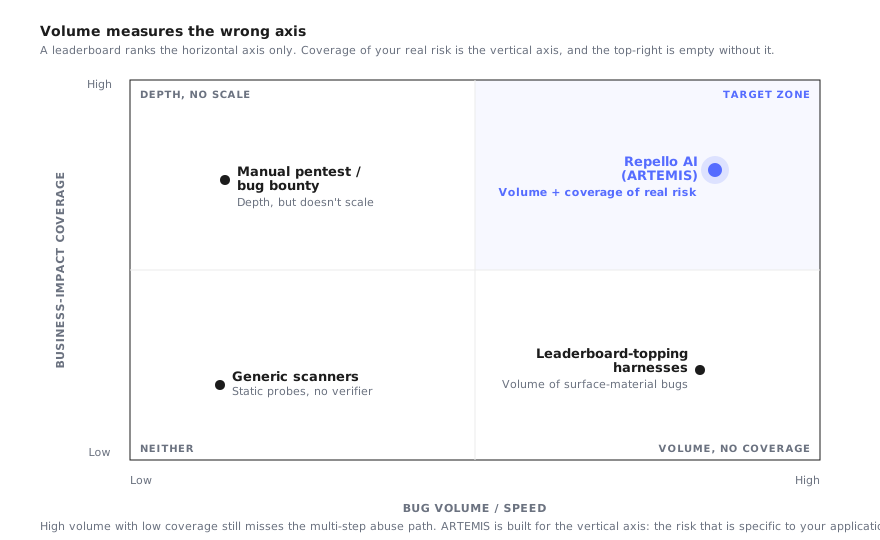
A leaderboard ranks only the horizontal axis; coverage of your real risk is the vertical one, and that is the axis ARTEMIS is built for.
It is the harness, not the model#
Here is the part that gets lost in the model-benchmark coverage. Most autonomous red teamers call the same frontier models. The model is a commodity layer that every vendor rents from the same handful of labs. The differentiator is the harness wrapped around the model, and the harness is an architecture decision, not a model choice.
Four components separate a strong harness from a thin one. Persistent attack memory lets the system carry state across turns: what it has already tried, which probes the target rejected, which response leaked a clue worth chasing. Without memory, every turn restarts the search. A verifier loop confirms a finding is real before it ships, which is the difference between a tool that reports 1,000 findings and a tool whose 1,000 findings are not mostly false positives. Traditional automated scanners drown teams in noise precisely because they have no verifier; the same failure mode applies to a thin AI harness.
The other two are where coverage actually comes from. An evolving payload library means the tool gets smarter over time, feeding successful attack patterns back into the next campaign rather than running the same static probe set against every target. Context-specificity means the tool tailors its attacks to the target (its role model, its data flows, its tool inventory) rather than firing a generic battery at an endpoint and hoping. A generic probe set finds generic bugs. A context-specific harness finds the bug that only exists because of how your application is built.
The practical implication for buyers: a strong harness on an average model beats a flashy model on a thin harness, every time, because offensive security is a multi-step search problem and the harness is what does the searching. The Wiz AI Cyber Model Arena benchmark, which ran agent-and-model combinations across 257 real-world offensive challenges, made the same point structurally: the agent harness and its native tooling shaped results as much as the underlying model did. So when a vendor leads with "we use the newest, biggest model," that is a commodity claim. Ask about the four harness components instead.
Coverage of the agentic surface#
The third gap is the one most "AI pentest" tools quietly leave open. Many of them test the model, or the chat endpoint, and stop there. The real 2026 attack surface is agentic, and it lives in the connective tissue between components rather than inside any single model.
Four surfaces matter, and a serious tool tests all four natively. Multi-agent orchestration introduces agent-to-agent message passing, where one agent's output becomes another agent's trusted instruction and a prompt injection propagates across the workflow. MCP tool poisoning abuses the Model Context Protocol: a malicious or compromised tool description is treated as a trusted instruction by the model, executing without ever appearing in the user prompt. RAG pipeline injection plants adversarial content in a retrieval corpus so that a document the agent treats as high-trust carries an attacker's payload into context. And tool-call boundaries are the general case: every point where untrusted output crosses into a privileged action is a test surface. Repello's deep guide to pentesting agentic AI maps these surfaces in full, and the connector-graph attack patterns in agentic AI browser security show how fast the surface grows once tools and connectors enter the picture.
None of these show up if you only probe the underlying model with prompts. They show up when the tool simulates an attacker targeting the deployed agent system, tracing a payload from an untrusted source, through retrieval or a tool call, into a privileged action. The OWASP Agentic Security Initiative exists because this surface is distinct from the model-level risks in the OWASP Top 10 for LLM Applications, and a tool that maps findings to MITRE ATLAS is one whose coverage you can actually audit against a public technique catalog.
The rubric question is direct: does the vendor test agentic surfaces natively, or is "agentic coverage" a roadmap slide. A tool that tests the endpoint and calls itself an AI pentester is covering a fraction of the surface and naming it the whole.
The eight-question evaluation rubric#
This is the artifact to bring to the demo. Eight questions, each with what a good answer sounds like. Write the questions down and make the vendor answer all eight on the first call. The rubric is vendor-neutral; the credibility of the exercise comes from its fairness, not from steering toward any one tool.
| # | Question | What a good answer looks like |
|---|---|---|
| 1 | How do you find business-logic flaws, not just pattern-matchable bugs? | A concrete method for using application context (role model, data flows, intended behavior) to construct multi-step abuse paths, not "our model is very capable." |
| 2 | What does your harness remember across turns? | Persistent attack memory: prior probes, rejected attempts, leaked signals carried forward. "Each request is independent" is a thin harness. |
| 3 | Do you have a verifier loop, and what is your false-positive rate? | A described confirm-before-report step and a real number. No verifier means the volume claim is mostly noise. |
| 4 | Does your payload library evolve, and from what? | Successful attack patterns fed back into future campaigns, with a source for new patterns. A static probe set finds static bugs. |
| 5 | Do you test agentic surfaces (MCP, multi-agent, RAG) natively? | Yes, with specifics on each: tool poisoning, agent-to-agent injection, retrieval poisoning, tool-call boundaries. Roadmap answers are a no. |
| 6 | Is testing context-specific to my application? | Attacks tailored to your stack, not a generic battery fired at an endpoint. Ask how the tool learns your context. |
| 7 | What requires a human, and when? | An honest boundary. The leaderboard-topping tool needs a human to point it and a human to validate findings. A vendor claiming zero humans is selling the investor deck. |
| 8 | How do findings map to OWASP and MITRE ATLAS? | Output mapped to OWASP LLM Top 10 and ATLAS technique IDs, so your team and your auditor can review coverage against a public taxonomy. |
A vendor that answers all eight concretely is selling coverage. A vendor that redirects every question back to a leaderboard position or a model name is selling volume with a ranking attached. The questions decode the difference in 30 minutes. For the contractual framing around these (scope, rules of engagement, deliverables) pair this rubric with the adversarial testing vs red teaming vs pentesting decoder, and for the engineer's-eye view of where an autonomous coding agent stops being a red-team harness, see the limits of using Claude Code as a red teamer.
Where ARTEMIS sits#
Repello built ARTEMIS for the coverage column of this rubric, not the volume column. It runs context-specific attack simulations tailored to the application under test rather than a generic probe battery fired at an endpoint, drawing from an evolving library of attack patterns mapped to OWASP LLM Top 10, NIST AI RMF, and MITRE ATLAS. The harness carries attack memory across turns and verifies findings before they surface, so the output is signal rather than a volume dump a human has to triage from scratch.
On the agentic surface, ARTEMIS tests the parts most endpoint-only tools skip: RAG pipelines, multi-agent orchestrations built on frameworks like LangGraph, CrewAI, and AutoGen, and MCP server integrations where tool poisoning lives. Coverage is multimodal across text, images, voice, and documents, because the attack surface is not text-only and a tool that only reads prompts misses the rest. The point is not that ARTEMIS tops a leaderboard. The point is that it answers all eight rubric questions concretely, which is the only test that maps to your real risk.
None of this removes the human. The honest position, and the one the public critiques of autonomous tools keep landing on, is that autonomous breadth plus human depth beats either alone. ARTEMIS is the always-on regression layer that scales the volume work; a scoped human engagement is the depth layer for the business-logic flaws and the multi-step campaigns. Buy the layer that matches the question you are asking.
Bring the rubric to a demo#
The eight questions are the wedge. Most vendors will answer one or two and redirect the rest to a leaderboard screenshot. The vendors worth buying answer all eight.
Book a demo and bring the rubric. We will go through business-logic coverage, what the harness remembers, the verifier loop and false-positive rate, the evolving payload library, native agentic coverage, context-specificity, the human-in-the-loop boundary, and the OWASP and ATLAS mapping, in order, on the call. Volume is easy to demo. Coverage is what you are buying.
FAQ#
What is an autonomous AI red teamer?#
An autonomous AI red teamer is a system that drives offensive security testing against a target with minimal human input: it discovers attack surface, generates payloads, runs them, observes responses, and iterates toward an objective. The current generation is built on agentic harnesses wrapped around frontier models. They are strongest at high-volume, pattern-matchable bugs and weakest at business-logic flaws that require understanding what the target application is for. Leaderboard-topping tools still require human review of every report before submission.
Is a leaderboard ranking a good way to choose an autonomous pentest vendor?#
No, because a leaderboard rewards volume and speed, not coverage of your specific risk. HackerOne's own data on the top-ranked autonomous tool showed it excelled in volume but not in business impact, with findings concentrated in surface-material categories like data leaks, XSS, and access control. A ranking tells you a tool can find many shallow bugs fast. It tells you nothing about whether the tool can find the multi-step abuse path that compromises your application. Evaluate coverage of your attack surface, not position on a public board.
Why is the harness more important than the model in an AI red teamer?#
The model is a shared commodity; most vendors call the same frontier models. The harness is the differentiator: persistent attack memory across turns, a verifier loop that confirms a finding is real before reporting it, an evolving payload library, and context-specificity to the target. A strong harness on an average model beats a flashy model on a thin harness, because offensive security is a multi-step search problem, not a single-shot generation problem. Ask vendors about architecture, not about which model they use.
What agentic attack surfaces should an autonomous red teamer cover in 2026?#
Beyond the model endpoint, the 2026 attack surface is agentic: multi-agent orchestration, MCP tool poisoning, RAG pipeline injection, and tool-call boundaries where untrusted output becomes a privileged instruction. Many tools that market themselves as AI pentesters only test the model or the chat endpoint. Ask whether the vendor tests multi-agent message passing, MCP server integrations, and retrieval pipelines natively, or whether agentic coverage is a roadmap item.
What questions should I ask an autonomous AI red teaming vendor?#
Eight questions decode most vendors. How does your tool find business-logic flaws, not just pattern-matchable bugs? What does your harness remember across turns? Do you have a verifier loop, and what is your false-positive rate? Does your payload library evolve, and from what? Do you test agentic surfaces (MCP, multi-agent, RAG) natively? Is testing context-specific to my application? What requires a human, and when? And how do findings map to OWASP and MITRE ATLAS? A vendor that answers all eight concretely is selling coverage, not leaderboard position.
Do autonomous AI red teamers replace human pentesters?#
Not yet, and not for the work that matters most. Even the leaderboard-topping autonomous tool requires a human to point it at a target and a human to validate every finding before submission, the latter a platform requirement for AI-generated bug bounty reports. Autonomous tools are excellent at scaling the volume layer: continuous, broad, pattern-matchable testing. The business-logic flaws, the multi-step abuse paths, and the context-specific attacks still need human ingenuity guiding the system. The right model is autonomous breadth plus human depth, not one replacing the other.