AI Security Posture Management (AI-SPM) is the discipline of continuously inventorying, assessing, and improving the security posture of every AI asset across an enterprise — models, agents, datasets, integrations, MCP servers, RAG pipelines, third-party APIs. It is the AI-native analog of CSPM (Cloud Security Posture Management) for cloud and DSPM (Data Security Posture Management) for data — same operational rhythm, different inventory.
What AI-SPM actually covers#
A mature AI-SPM program tracks four categories of asset:
-
Models in use — every foundation model API integration, every fine-tuned model, every adapter, every distilled variant. Including shadow-AI models — usage that didn't go through procurement or security review.
-
Agentic deployments — every AI agent in production, with its connected tools, data sources, MCP servers, and authority scope.
-
AI training and inference data flows — what data crosses into model context, what data is used for fine-tuning, what data is in retrieval indexes. Maps to data classifications (PII, PHI, regulated, internal-only).
-
Third-party integrations — every embedding API, every RAG provider, every AI SaaS that holds enterprise data. Each is a third-party security dependency.
For each asset, AI-SPM tracks: what it is, where it lives, who owns it, what data flows through it, what its security controls are, and what its current risk score is.
Why AI-SPM is its own discipline#
Existing security tooling — vulnerability scanners, CSPM, SIEM, DLP — doesn't see AI assets natively:
- Model integrations don't appear in vulnerability scans. A
pip install langchainfollowed by an OpenAI API call doesn't surface as a security event. - Shadow AI usage is invisible to traditional MDM/EDR. Employees connecting personal ChatGPT, Claude, or Cursor accounts to enterprise data go unmonitored.
- Agentic systems have no equivalent to network firewall rules. Tool authorities and prompt-time data flows live above the network layer.
- Data lineage doesn't reach into model context. Standard DSPM tools track data at rest and in transit, not "this PII was retrieved into a model's context window."
The AI-SPM workflow#
A continuous loop:
- Discover — automated discovery of AI assets across cloud accounts, repositories, browser usage, and inbound traffic
- Classify — categorize each asset by sensitivity, regulatory regime, and business criticality
- Assess — measure current security posture against frameworks (OWASP LLM Top 10, NIST AI RMF, ISO 42001)
- Prioritize — rank gaps by impact × likelihood, surface to owners
- Remediate — apply controls, with verification
- Monitor — continuous visibility on changes, new assets, drift
How it differs from AI red teaming#
- Red teaming finds specific exploitable vulnerabilities through adversarial probing
- AI-SPM maintains continuous visibility on the whole inventory and tracks posture over time
They're complementary: red teaming finds the holes, AI-SPM ensures you know what assets exist to test in the first place.
See also#
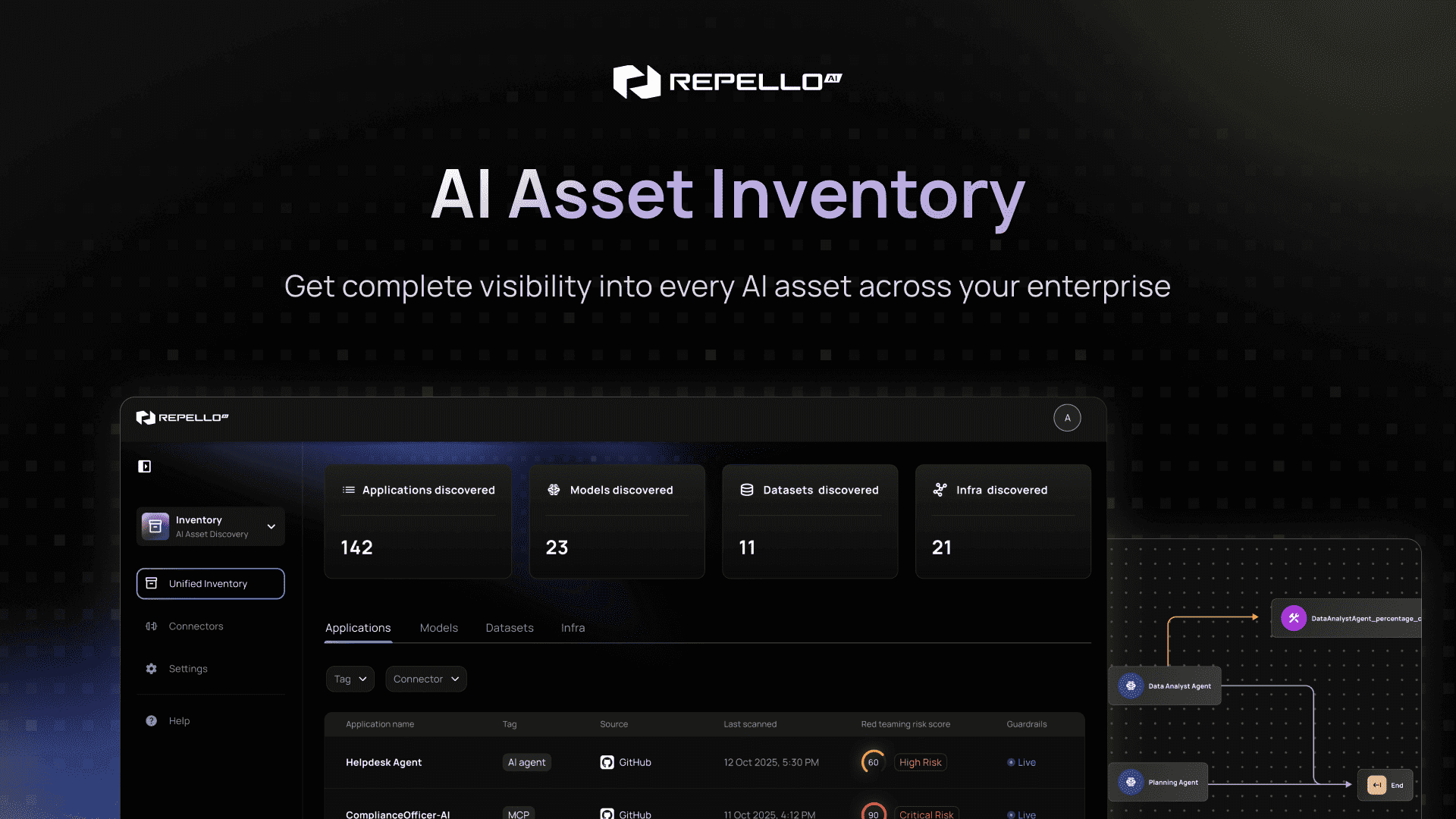
Repello's VANTAGE framework lays out the full operational model. The product side is AI Asset Inventory.